The Story
The journey of mtDNA haplogroup U5B1B1A4
Origins and Evolution
mtDNA haplogroup U5B1B1A4 is a terminal subclade nested within U5B1B1A, itself a branch of the wider U5B1B1 → U5B1 → U5 stem. The parent clade U5B1B1A has been dated to the late Bronze Age / Iron Age in northern or central Europe (approximately 3.5 kya). Based on its phylogenetic position and limited available ancient DNA, U5B1B1A4 likely arose subsequently within the same broad region during the late Bronze Age to Iron Age transition (I estimate roughly ~2.5 kya), though uncertainty remains because of sparse calibration points for this specific terminal lineage.
As a maternal marker, U5B1B1A4 represents a branch of the U5 family that has deep Mesolithic roots in Europe (U5 broadly is one of the oldest European maternal lineages), but the specific U5B1B1A substructure reflects later regional differentiation, likely driven by localized drift, founder effects, and demographic continuity in northern Scandinavia.
Subclades
U5B1B1A4 is currently defined as a downstream (terminal) clade of U5B1B1A by diagnostic coding-region and control-region mutations. At present there are no widely recognized, well-sampled downstream subclades with broad geographic characterization; many samples assigned to U5B1B1A4 show private mutations that may represent recently arisen local branches. Continued high-resolution sequencing (full mitogenomes) and expanded ancient DNA sampling could reveal minor downstream branches.
Geographical Distribution
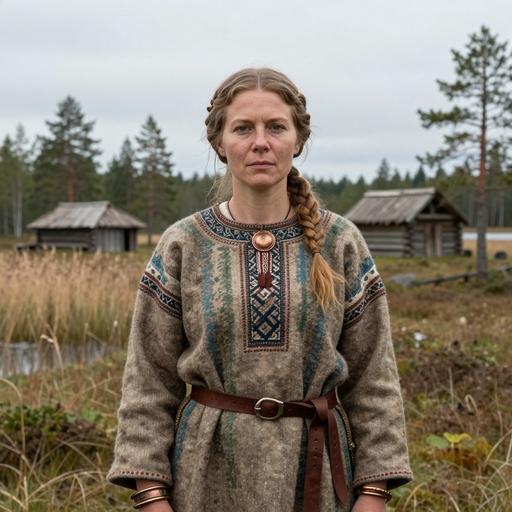
The distribution of U5B1B1A4 is concentrated in northern Scandinavia with the highest relative frequencies and phylogenetic diversity found among Saami (Sápmi) maternal lineages, consistent with long-term regional continuity and localized founder effects. Outside northern Scandinavia the haplogroup appears at low to moderate frequencies in broader Scandinavian populations (Norway, Sweden, Denmark) and at lower frequencies across the British Isles, Iberia, and parts of Central and Eastern Europe (Poland, Germany, Baltic region, Russia). Very low-frequency occurrences have been reported in North African (Berber-associated) groups and some Caucasus samples, which likely reflect rare long-distance gene flow or shared older European maternal lineages rather than major demographic events centered on those regions.
Two archaeological/ancient DNA samples in current databases have been assigned to this subclade (or closely related U5B1B1A-level lineages), providing direct temporal anchors that support a multi-millennial presence in northern Europe but do not yet define a precise coalescence date for the terminal U5B1B1A4 node.
Historical and Cultural Significance
Because U5B1B1A4 is nested within a clade that likely differentiated during the late Bronze Age / Iron Age, its modern geographic pattern reflects processes important in northern Europe during and after those eras: regional continuity of maternal lines, small-scale demographic drift in peripheral populations, and later population movements (for example, Viking Age mobility) that redistributed lineages at low frequency across Europe. The strong association with Saami maternal pools suggests founder effects and long-term isolation in northern Fennoscandia that preserved particular U5B lineages while neighboring populations experienced different maternal turnovers.
It is important to stress that mtDNA traces only the maternal line and so provides a partial view of population history; autosomal and Y-chromosome data are necessary to reconstruct the full demographic picture. The presence of U5B1B1A4 in western and southern Europe at low frequency may reflect older pan-European distributions of U5-derived lineages or later episodic gene flow rather than major migrations originating from Scandinavia.
Conclusion
U5B1B1A4 is a recently defined terminal branch of the deeply European U5 lineage, with a probable origin in northern/central Europe during the late Bronze Age to Iron Age and a modern concentration in northern Scandinavia, particularly among Saami people. Its pattern illustrates how maternal lineages can persist and differentiate regionally through a combination of continuity, drift, and limited gene flow. Further mitogenome sequencing and ancient DNA sampling across northern and western Europe will improve dating precision and clarify any minor downstream structure within U5B1B1A4.
Key Points
- Origins and Evolution
- Subclades
- Geographical Distribution
- Historical and Cultural Significance
- Conclusion