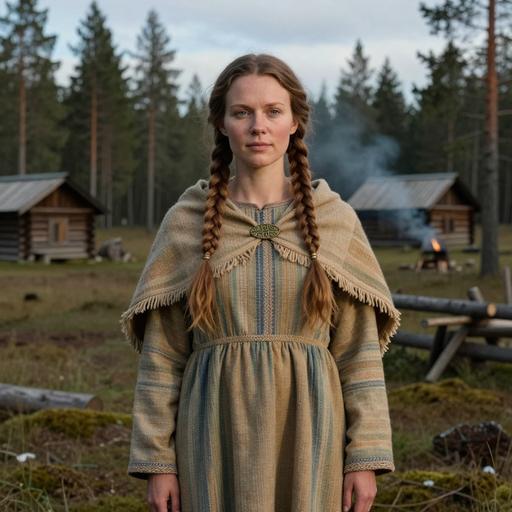
The Story
The journey of mtDNA haplogroup U5B1B1A1
Origins and Evolution
U5B1B1A1 is a derived subclade of U5B1B1A, itself a subgroup of the ancient European maternal haplogroup U5. Broadly speaking, haplogroup U5 traces back to Paleolithic and Mesolithic Europe as one of the continent's earliest and most persistent maternal lineages. The U5B branch diversified after the Last Glacial Maximum and several downstream lineages (including U5B1 and U5B1B1) show later regional differentiation. U5B1B1A appears to have formed in northern/central Europe in the late Bronze Age to Iron Age timeframe (parent clade ~3.5 kya), and U5B1B1A1 represents a further branching event likely occurring shortly thereafter (~3.0 kya), consistent with localized maternal drift and population continuity in northern Scandinavia.
Subclades (if applicable)
U5B1B1A1 is itself a terminal or near-terminal subclade in many observed datasets, with few widely recognized downstream branches documented to date. Where sub-branching exists, it is typically at low frequency and regionally restricted (for example, variants observed primarily in northern Fennoscandia). Because this lineage has limited representation in large public databases and appears in a small number of ancient samples, formal naming of further subclades may be sparse until additional high-coverage mitogenomes are published.
Geographical Distribution
The strongest modern signal for U5B1B1A1 is in northern Scandinavia, with highest frequencies and diversity observed among Sámi groups in Sápmi and adjacent Kola Peninsula areas. The lineage is also present, at lower frequencies, across other parts of Scandinavia (Norway, Sweden, Denmark), the British Isles (England, Scotland, Ireland), Iberia (Spain, Portugal), and in parts of central and eastern Europe (Poland, Germany, the Baltic states, western Russia). Occasional low-frequency occurrences have been reported in northwestern North Africa (Berber-speaking groups and nearby populations) and the Caucasus, consistent with episodic long-distance gene flow or historic mobility. Ancient DNA datasets include a small number of occurrences (two identified samples in the referenced database), supporting a late Bronze Age / Iron Age age and northern European placement of the lineage.
Historical and Cultural Significance
Because U5 is an older Mesolithic lineage, later derivatives such as U5B1B1A1 represent the persistence and local evolution of deep maternal ancestry within European populations. The concentration of U5B1B1A1 in Sámi and northern Scandinavian samples points to maternal continuity in Fennoscandia through Bronze Age and Iron Age transitions and into the historical period, despite cultural and linguistic shifts. In broader western and central Europe, low-frequency occurrences likely reflect both ancient pockets of hunter-gatherer–derived maternal ancestry and later demographic events (migration, trade, and small-scale mobility) that moved lineages across regions. The association with northern Scandinavia links this haplogroup to the demographic history of arctic and subarctic Europe, including adaptations to high-latitude environments and the ethnogenesis of Sámi groups.
Conclusion
U5B1B1A1 is a regionally informative mtDNA subclade that illustrates how deep Paleolithic and Mesolithic maternal lineages persisted and differentiated in Europe into the Bronze and Iron Ages. Its strongest modern signal in northern Scandinavia—especially among Sámi populations—makes it useful for studies of maternal continuity in Fennoscandia, while its sporadic presence elsewhere highlights the mobility and complex demographic history of Europe over the last several thousand years. Future high-coverage ancient and modern mitogenomes from northern Eurasia will refine the phylogeny and geographic history of this lineage.
Key Points
- Origins and Evolution
- Subclades (if applicable)
- Geographical Distribution
- Historical and Cultural Significance
- Conclusion