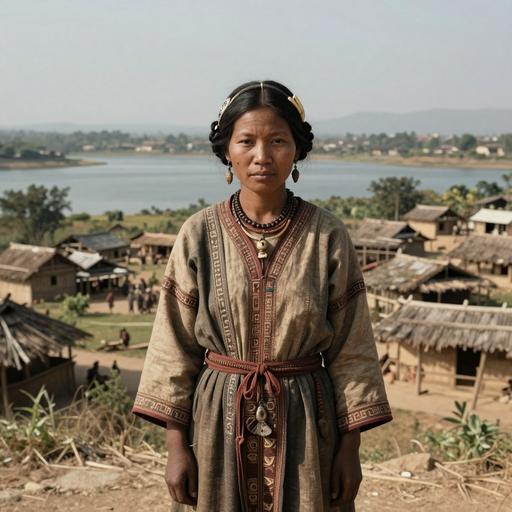
The Story
The journey of mtDNA haplogroup M13A
Origins and Evolution
mtDNA haplogroup M13A is an internal branch of the broader M13 lineage (parent clade M13A'B) within macro-haplogroup M, a major maternal lineage that diversified in Eurasia after the initial OOA (Out of Africa) dispersals. Based on its phylogenetic position relative to other M13 branches and the geographic patterning of related lineages, M13A most likely arose in East Asia during the Late Pleistocene (we provisionally estimate a coalescence on the order of ~18 kya, acknowledging substantial uncertainty due to limited published sequence data). As an intermediate clade, M13A helps connect deeper M13 diversity to downstream, regionally restricted subclades.
Subclades
At present, the internal structure of M13A is incompletely resolved in published phylogenies. A limited number of complete mtDNA sequences assigned to M13 show splits that place M13A as a distinct branch under M13A'B, with further sub-branches that require denser sampling and full mitochondrial genome sequencing to define formally. Because sampling is sparse, recognized subclades of M13A (if present) are likely underspecified and may be discovered or renamed as more whole-mtDNA data become available.
Geographical Distribution
Published and population-level surveys suggest that M13 and its sublineages are primarily an East Asian phenomenon; M13A is detected at low to moderate frequencies in some East Asian populations and occasionally in neighboring regions of Northeast and Southeast Asia. Reported occurrences are patchy rather than ubiquitous, consistent with an origin in the Pleistocene followed by localized demographic processes (founder effects, drift, and small-scale expansions). Given current data, the plausible geographic footprint for M13A includes:
- Northern and insular East Asia (including parts of the Japanese archipelago and the Korean peninsula)
- Selected mainland East Asian groups (regional Han, Tibeto-Burman or other East Asian populations in low frequency)
- Scattered occurrences in coastal Southeast Asian island populations, reflecting coastal dispersal and later mobility
These distribution inferences are provisional: future dense sampling across East and Southeast Asia and additional full-genome mitogenomes are necessary to refine range and frequency estimates.
Historical and Cultural Significance
From a population-genetic perspective, M13A likely represents a lineage associated with Late Pleistocene and early Holocene hunter-gatherer populations in East Asia, contributing a minor maternal component to the genetic makeup of some modern East Asian and island populations. Its pattern — localized presence, low-to-moderate frequency, and internal fragmentation — is compatible with scenarios of early settlement followed by long-term regional continuity and genetic drift rather than large-scale replacement by later farming-associated migrations. There are hypotheses that lineages like M13 and its subclades contributed to the maternal ancestry of prehistoric groups such as the Jomon of Japan or other coastal forager groups, but direct links must be treated cautiously until more ancient DNA and comparative modern sequences are available.
Conclusion
M13A is an intermediate, regionally focused mtDNA clade nested within the broader M13 family. It provides useful phylogeographic information about maternal lineage diversification in East Asia during the Late Pleistocene and early Holocene, but current understanding is limited by sparse sampling and incomplete mitogenome resolution. Targeted whole-mtDNA sequencing of under-sampled East and Southeast Asian populations and integration with ancient DNA will be essential to clarify the age, structure, and historical movements associated with M13A.
Key Points
- Origins and Evolution
- Subclades
- Geographical Distribution
- Historical and Cultural Significance
- Conclusion