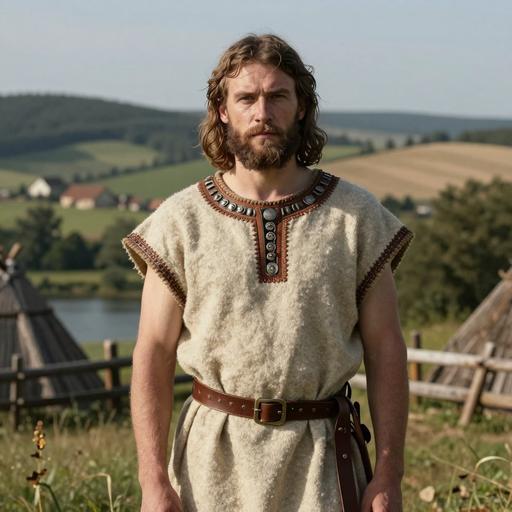
The Story
The journey of mtDNA haplogroup U5B1B1D
Origins and Evolution
U5B1B1D sits deep within the broader mtDNA haplogroup U5, a lineage widely recognized as one of the principal maternal components of European Mesolithic hunter-gatherers. The parent clade U5 (and subclade U5b) originated much earlier — generally associated with Upper Paleolithic and post-Last Glacial Maximum (LGM) expansions in Europe — but the specific terminal subclade U5B1B1D shows a pattern consistent with a more recent derivation from U5b1-derived diversity. Based on its nested placement (U5 → U5b → U5b1 → U5b1b → U5B1B1D) and the naming convention indicating multiple successive mutations, its time depth is best interpreted as being late Neolithic to Bronze Age in age (a few thousand years ago), although precise dating requires calibrated ancient DNA or coalescent analyses.
Because U5 lineages generally reflect long-standing European maternal continuity, U5B1B1D most likely arose within populations already carrying U5-derived haplotypes rather than representing a recent external introduction. The clade's relative recency and low reported frequency imply local differentiation after regional demographic events (e.g., Bronze Age movements, founder effects, or isolation in refugial/insular populations).
Subclades
At present U5B1B1D is treated as a terminal or intermediate micro-clade in phylogenies (Phylotree-style classifications). There are no well-documented downstream subclades in the public literature widely recognized by stable names; many of these fine-scale branches are still being refined as more full mitogenomes are sampled. Thus, U5B1B1D should be considered an intermediate/terminal lineage pending further sequencing and naming of its descendants.
Geographical Distribution
Observed and inferred occurrences of U5B1B1D are largely within Western and parts of Southern Europe, consistent with the distribution of other U5b-derived lineages. Modern and ancient DNA sampling remains sparse for this specific subclade, so reported occurrences often come from targeted mitogenome studies or unpublished community datasets. Regions with plausible detections or where closely related U5b1 subclades are common include:
- Iberian Peninsula (including Basque-adjacent populations)
- Sardinia and other Mediterranean islands with isolated maternal pools
- Southern France and adjacent parts of Western Europe
- Low-frequency presence in northern and Atlantic-edge populations (British Isles, parts of Scandinavia) reflecting postglacial and later movements
Because sampling is incomplete, the absence of recorded occurrences in a region should not be taken as definitive evidence that the clade is absent.
Historical and Cultural Significance
U5 and its subclades are strongly associated with European hunter-gatherer ancestry and represent one of the oldest continuous maternal threads in Europe. For U5B1B1D specifically, the cultural significance is primarily inferential: its origin timing and geography are consistent with local differentiation during the Bronze Age or later, meaning it could reflect demographic processes such as small-scale migrations, founder effects in isolated communities (islands, mountain valleys), or assimilation of hunter-gatherer-derived maternal lineages into farming and later pastoral societies.
Associations with archaeological cultures are tentative: U5 lineages were present among Mesolithic groups but many modern U5 subclades persisted through Neolithic and Bronze Age demographic turnovers. As a low-frequency, derived subclade, U5B1B1D may mark localized maternal continuity rather than large-scale cultural expansions.
Conclusion
U5B1B1D is best understood as a recent, low-frequency European branch of the ancient U5 maternal tree. It illustrates how deep Paleolithic lineages continued to diversify regionally over millennia. Definitive statements about its origin, distribution, and demographic role require larger numbers of complete mitochondrial genomes and ancient DNA samples; until then, inferences remain cautious and grounded in the broader behavior of U5b lineages in European population genetics.
Key Points
- Origins and Evolution
- Subclades
- Geographical Distribution
- Historical and Cultural Significance
- Conclusion