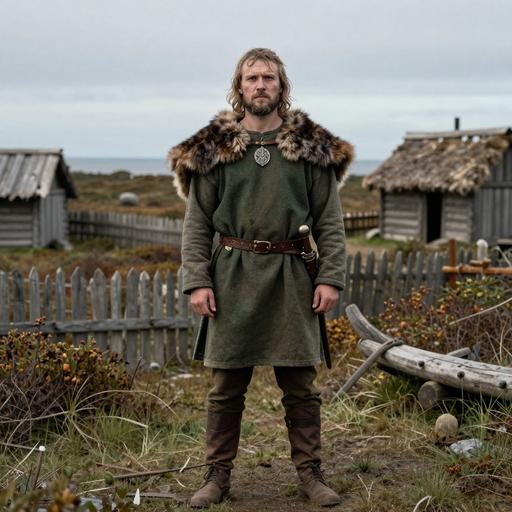
The Story
The journey of Y-DNA haplogroup I1A2A1
Origins and Evolution
Y-DNA haplogroup I1A2A1 is a subclade of I1A2A, itself part of the broader I1 paternal lineage. The I1 branch is widely interpreted as a major northern European Y-chromosome lineage that diversified after the Last Glacial Maximum, with deep roots in Mesolithic Europe and a later strong association with Scandinavia.
Because I1A2A1 is a downstream branch of I1A2A, its formation likely occurred through the accumulation of regional mutations within a population already established in northern Europe. While the precise age of I1A2A1 depends on future phylogenetic refinement and sample discovery, a reasonable estimate places its origin in the early to middle Holocene, roughly around 9.5 kya in broad lineage context. This fits a pattern of post-glacial expansion, local differentiation, and subsequent demographic spread.
Subclades
As an intermediate-to-derived branch, I1A2A1 represents a finer level of structure within the I1 tree. Its exact downstream branching may still be incompletely resolved in public phylogenies, but its placement implies that it is more recent than I1A2A and more regionally specific than the parent I1 lineage.
In practical population-genetic terms, such subclades often arise from:
- Founder effects in small or semi-isolated populations
- Regional continuity across multiple prehistoric phases
- Secondary dispersals during the Bronze Age, Iron Age, Viking Age, and medieval periods
Geographical Distribution
Haplogroup I1A2A1 is expected to occur at the highest frequencies in Scandinavia and nearby north-central European populations, especially where the broader I1 lineage is common. Its distribution is likely patchy, reflecting local drift and historical migrations rather than uniform spread.
Typical regions where related I1 subclades are found include:
- Scandinavia, including Sweden, Norway, Denmark, and parts of Finland
- German-speaking central Europe, including Germany and Austria
- The British Isles, especially populations with substantial northern European ancestry
- Baltic and eastern Baltic-adjacent populations
- East Slavic and Balkan populations, usually at lower frequency and often via historical gene flow
- Diaspora populations in North America and Australia due to recent migration
Historical and Cultural Significance
The broader I1 lineage is often discussed in relation to northwestern and northern European prehistory, including post-glacial hunter-gatherer continuity and later population restructuring. While no single archaeological culture can be assigned specifically to I1A2A1 without direct ancient DNA evidence, the lineage’s parent branches are broadly compatible with several major episodes of European demographic change.
Relevant historical contexts for this lineage include:
- Mesolithic hunter-gatherer continuity in northern Europe
- Neolithic and Chalcolithic contact zones in the north-central European corridor
- Bronze Age population expansions that increased connectivity across Scandinavia, the Baltic, and central Europe
- Iron Age and Germanic-era dispersals, including movements that helped shape modern northern European Y-chromosome landscapes
- Viking Age expansion, which contributed to the wider spread of Scandinavian paternal lineages across the North Atlantic and parts of continental Europe
Interpretation in Population Genetics
Because haplogroups like I1A2A1 are defined by their place in the Y-chromosome tree, their significance lies in paternal lineage history, not in cultural identity by itself. A man carrying this haplogroup may descend from ancient northern European paternal ancestors, but the exact ethnic, linguistic, or national affiliation of any present-day carrier depends on much later family history.
From a genetic genealogy perspective, I1A2A1 is important because it helps refine the internal structure of I1 and may identify more specific paternal connections among families with northern European roots.
Conclusion
Y-DNA haplogroup I1A2A1 is a relatively specific northern European paternal lineage within the broader I1 clade. Its likely formation in post-glacial northern Europe, combined with later founder effects and historical expansions, makes it a useful marker of deep regional ancestry in Scandinavia and adjacent parts of Europe.
Key Points
- Origins and Evolution
- Subclades
- Geographical Distribution
- Historical and Cultural Significance
- Interpretation in Population Genetics