Menu
Currency
Main
Store
Blog

Loading Report

Preparing your ancestry journey

Connecting to ancient matches...

Preparing your report

Skip to main content
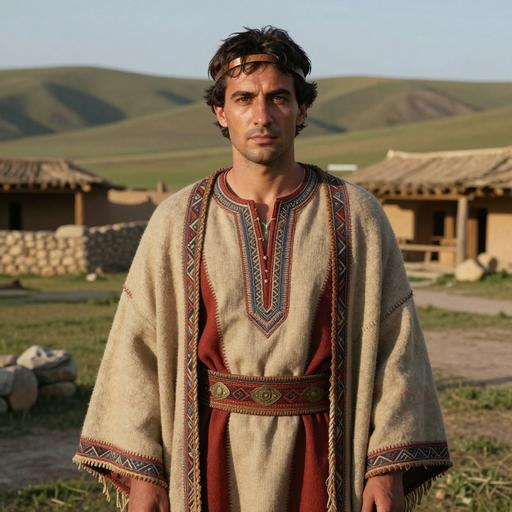
Portrait reconstruction of A man buried in Azerbaijan in the Iron Age era
Ancient Individual

A man buried in Azerbaijan in the Iron Age era

A man buried in Azerbaijan during the Shamakhi Culture

A fragment of the ancient world, preserved across millennia in strands of DNA.

zrj003
205 CE - 346 CE
Male
Azerbaijan
Scroll to begin
Chapter I

Identity

The biological and cultural markers that define this ancient individual

Sample ID

zrj003

Date Range

205 CE - 346 CE

Cultural Period

Shamakhi Culture

Biological Sex

Male

mtDNA Haplogroup

K1a19

Y-DNA Haplogroup

J-Z1842

Chapter II

Place

Where this individual was discovered

Country Azerbaijan
Locality Shamakhi
Coordinates 40.6300, 48.6200
Chapter III

Time

When this individual lived in the broader context of human history

zrj003 205 CE - 346 CE
Chapter IV

Story

The narrative of this ancient life

The Shamakhi Culture of the Caucasus is a fascinating and multi-faceted subject that encompasses the historical, geographical, social, and artistic aspects of a region that has been at the crossroads of civilizations for centuries. Shamakhi, located in modern-day Azerbaijan, is one of the oldest cities in the region and has played a pivotal role in the development of the Caucasian cultural landscape.

Historical Context

Shamakhi has a rich historical narrative that dates back more than two millennia. It served as the capital of the Shirvanshah dynasty from the 9th to 16th centuries, which greatly influenced the culture and architecture of the region. Due to its strategic location on the Silk Road, Shamakhi was a vibrant center for trade, linking the East and West. This interaction facilitated an exchange of ideas, goods, and cultural practices, contributing to its unique cultural heritage.

Throughout its history, Shamakhi has been conquered and influenced by various empires, including the Persian, Arab, Mongol, Ottoman, and Russian Empires. Each of these powers left its mark on the cultural and social fabric of the city, thus creating a melting pot of traditions, languages, and religions.

Geographical Influence

Nestled in the picturesque landscape of north-central Azerbaijan, Shamakhi is surrounded by the Greater Caucasus mountains to the north and the Shirvan plain to the south. This diverse topography has influenced the local lifestyle, economy, and architecture. The region is known for its viniculture, and winemaking is an important cultural and economic activity. The fertile soil and favorable climate have also supported agriculture, creating a tradition of rich, locally-grown food.

Language and Religion

Language and religion in Shamakhi have evolved as a result of its complex history. While Azerbaijani is the predominant language today, historical influences have introduced Persian, Arabic, and Russian into the cultural lexicon. Religious practices also reflect this diversity: Islam, particularly Shia Islam, is the major religion, but there are also historical traces of Zoroastrianism, Christianity, and ancient pagan practices.

Arts and Literature

The arts have flourished in Shamakhi, with a strong emphasis on poetry, music, and dance. Shamakhi was the birthplace of the renowned Persian poet Nizami Ganjavi, whose works are celebrated throughout the Middle East and Central Asia. Poetry and literature from the region often explore themes of love, nature, and philosophy, reflecting the complex spiritual and emotional life of its people.

Music and dance are integral to the Shamakhi culture, with the Mugham—a traditional Azerbaijani musical form similar to a classical suite—and the Lezginka dance being particularly popular. The music often features traditional instruments like the tar, kemancha, and daf, and is characterized by intricate melodies and improvisation.

Architecture

Architecture in Shamakhi combines Persian, Islamic, and local influences. The city is home to several historical landmarks, such as the Juma Mosque, one of the oldest mosques in the Caucasus, which has been rebuilt multiple times due to seismic activity. The architectural style is defined by elegant minarets, domes, and intricate stonework, showcasing the craftsmen's skills and the diverse cultural influences that have converged in the region.

Social Structure and Traditions

The social structure of Shamakhi historically has revolved around clan and family ties, with a strong emphasis on hospitality, respect for elders, and community cohesion. Traditional events and festivals, like Novruz Bayram, celebrate the coming of spring and are marked by communal gatherings, music, dance, and shared meals.

In conclusion, the Shamakhi Culture of the Caucasus is a testament to the region's resilience and adaptability. It represents a unique synthesis of diverse influences while maintaining its distinct local flavor—a rich tapestry woven through history, geography, art, and social customs.

Context

Related Samples

This individual exists within a broader network of ancient samples. No ancient genome stands alone.

Sample ID Culture/Period Date Location Action
BOG019 Turkey Central Bogazkoy-Hattusa Roman Imperial 100 CE Boğazköy-Ḫattuša (Çorum, Boğazkale), Turkey View
BOG020 Turkey Central Bogazkoy-Hattusa Roman Imperial 130 CE Boğazköy-Ḫattuša (Çorum, Boğazkale), Turkey View
BOG024 Turkey Central Bogazkoy-Hattusa Roman Imperial 130 CE Boğazköy-Ḫattuša (Çorum, Boğazkale), Turkey View
BOG028 Modern Turkish (Boğazköy-Hattuša) 1000-1900 CE 1000 CE Boğazköy-Ḫattuša (Çorum, Boğazkale), Turkey View
CTG025 Bronze Age Aegean Culture of Aydin 2015 BCE Çine-Tepecik (Aydın, Çine), Turkey View
G23 Early Bronze Age Theopetra Culture 2343 BCE Theopetra Cave (Thessaly), Greece View
G31 Early Helladic Perachora 2700 BCE Perachora Cave (Corinthia), Greece View
G37 Early Bronze Age Sarakenos Cave Culture 2476 BCE Boeotia, Sarakenos Cave (Thessalia-Central Greece, Stereas Elladas), Greece View
G62 Early Helladic Perachora 2700 BCE Perachora Cave (Corinthia), Greece View
G65 Early Helladic Perachora 2700 BCE Perachora Cave (Corinthia), Greece View
G66 Early Helladic Perachora 2700 BCE Perachora Cave (Corinthia), Greece View
G76a Early Helladic Perachora 2570 BCE Perachora Cave (Corinthia), Greece View
geo005 Didnauri Culture of Georgia 1260 BCE Didnauri (Samreklo), Georgia View
geo006 Didnauri Culture of Georgia 1043 BCE Didnauri (Samreklo), Georgia View
geo015 Kura-Araxes Culture 3017 BCE Doghlauri (Shida Kartli, Kareli), Georgia View
geo017 Doghlauri culture of Georgia 1375 BCE Doghlauri (Shida Kartli, Kareli), Georgia View
geo029 Didnauri Culture of Georgia 1222 BCE Didnauri (Samreklo), Georgia View
Gordion002 Central Anatolian Iron Age Culture (Gordion) 323 BCE Gordion (Central, Ankara), Turkey View
gur016 Nazarlebi Culture of Georgia 1500 BCE Nazarlebi (Eastern Georgia, Kakheti, Shiraki Plain), Georgia View
gur017 Nazarlebi Culture of Georgia 1500 BCE Nazarlebi (Eastern Georgia, Kakheti, Shiraki Plain), Georgia View
gur019 Nazarlebi Culture of Georgia 1500 BCE Nazarlebi (Eastern Georgia, Kakheti, Shiraki Plain), Georgia View
mus005 Central Anatolian Pre-Pottery Neolithic 7457 BCE Musular (Aksaray, Gülağaç), Turkey View
mus006 Central Anatolian Pre-Pottery Neolithic 7311 BCE Musular (Aksaray, Gülağaç), Turkey View
sha003 Bronze Age Shah Tepe 3200 BCE Shah Tepe (Kerman, Arzuiyeh), Iran View
sha004 Bronze Age Shah Tepe 3489 BCE Shah Tepe (Kerman, Arzuiyeh), Iran View
sha006 Bronze Age Shah Tepe 3200 BCE Shah Tepe (Kerman, Arzuiyeh), Iran View
sha007 Bronze Age Shah Tepe 3369 BCE Shah Tepe (Kerman, Arzuiyeh), Iran View
sha008 Bronze Age Shah Tepe 3200 BCE Shah Tepe (Kerman, Arzuiyeh), Iran View
sha009 Bronze Age Shah Tepe 3346 BCE Shah Tepe (Kerman, Arzuiyeh), Iran View
sha010 Bronze Age Shah Tepe 3200 BCE Shah Tepe (Kerman, Arzuiyeh), Iran View
sha012 Bronze Age Shah Tepe 3200 BCE Shah Tepe (Kerman, Arzuiyeh), Iran View
ksha014 Bronze Age Shah Tepe 3200 BCE Shah Tepe (Kerman, Arzuiyeh), Iran View
ulu117 Early Bronze Age Ulucak Culture 4000 BCE Ulucak Höyük (İzmir, Kemalpaşa), Turkey View
zrj003 Shamakhi Culture 205 CE Shamakhi, Azerbaijan View
Sample ID Culture/Period Date Location Action
zrj003 Shamakhi Culture 205 CE Shamakhi, Azerbaijan View
Sources

References

Scientific publications and genetic data that inform this profile.

Scientific Publication

Spatial and temporal heterogeneity in human mobility patterns in Holocene Southwest Asia and the East Mediterranean

Authors Koptekin D, Yüncü E, Rodríguez-Varela R, Altınışık NE, Psonis N et al.
Abstract

We present a spatiotemporal picture of human genetic diversity in Anatolia, Iran, Levant, South Caucasus, and the Aegean, a broad region that experienced the earliest Neolithic transition and the emergence of complex hierarchical societies. Combining 35 new ancient shotgun genomes with 382 ancient and 23 present-day published genomes, we found that genetic diversity within each region steadily increased through the Holocene. We further observed that the inferred sources of gene flow shifted in time. In the first half of the Holocene, Southwest Asian and the East Mediterranean populations homogenized among themselves. Starting with the Bronze Age, however, regional populations diverged from each other, most likely driven by gene flow from external sources, which we term "the expanding mobility model." Interestingly, this increase in inter-regional divergence can be captured by outgroup-f3-based genetic distances, but not by the commonly used FST statistic, due to the sensitivity of FST, but not outgroup-f3, to within-population diversity. Finally, we report a temporal trend of increasing male bias in admixture events through the Holocene.

Use code for 25% off Expires Jul 12