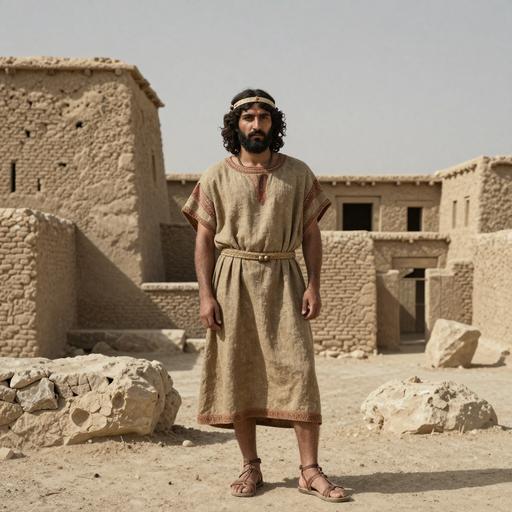
The Story
The journey of Y-DNA haplogroup J2A1A1A2B2
Origins and Evolution
Y-DNA haplogroup J2A1A1A2B2 is a very specific subclade within J2a, a major paternal lineage most strongly associated with the Near East and the broader eastern Mediterranean sphere. As a downstream branch of J2A1A1A2B, it likely arose from an ancestral J2a lineage already established in populations of the Levant, Anatolia, northern Mesopotamia, or adjacent highland zones. Because it is so deeply nested, its present-day frequency is expected to be low, with distribution shaped by a combination of regional continuity, small founder effects, and local demographic expansions over the last several thousand years.
The estimated origin time for this branch is around 4.0 kya, though the deeper ancestry of the lineage is considerably older and tied to the spread of J2a during the Neolithic and Bronze Age transitions in Western Asia. Like other highly resolved J2a branches, J2A1A1A2B2 likely reflects the fragmentation of an older regional paternal network rather than a single sweeping migration event.
Subclades
As an intermediate-to-terminal branch, J2A1A1A2B2 sits within a hierarchical tree that connects broader J2a diversity to very localized paternal lines. At this level, subclade structure is often important for identifying regionally restricted families and historical population movements.
- Parent lineage: J2A1A1A2B
- Broader haplogroup: J2a
- Higher-level background: J2, a major West Eurasian Y-chromosome clade
Because the branch is rare, many populations will carry it only at trace levels or as part of a small number of unrelated paternal lines. Any further downstream sub-branches, if discovered through sequencing, are likely to be geographically or genealogically informative.
Geographical Distribution
The strongest expectation for J2A1A1A2B2 is a distribution centered on the Near East and surrounding West Asian regions. It may be found in low frequencies among:
- Levantine populations
- Anatolian populations
- Mesopotamian populations
- Caucasus populations
- Iranian plateau populations
- Arabian Peninsula populations
- Jewish populations
- Southeastern European populations, especially in areas with long historical contact with Anatolia and the Levant
This pattern is consistent with other rare J2a subclades, which often appear in populations linked by ancient trade, imperial networks, religious diaspora, and long-term regional intermarriage. The lineage’s distribution is best understood as patchy and localized, not uniformly spread across any single modern population.
Historical and Cultural Significance
J2a lineages are frequently discussed in relation to the spread of agriculture, sedentary village lifeways, and the later growth of Bronze Age urban and state societies in Western Asia. While J2A1A1A2B2 itself is too rare to be tied confidently to one specific archaeological culture, its deeper ancestral context is compatible with populations involved in the Pre-Pottery Neolithic, Chalcolithic, and Bronze Age cultural horizons of the Near East.
More recent historical processes likely influenced its distribution as well, including:
- Levantine and Anatolian population continuity
- Caucasus and Mesopotamian regional interactions
- Greek, Roman, Byzantine, and Islamic-era mobility
- Jewish diaspora dispersals across the Mediterranean and Middle East
Because rare subclades can survive at low frequencies in endogamous or semi-endogamous communities, the lineage may also appear in family-based clusters within some modern populations, especially where historical founder effects have preserved ancient paternal lines.
Interpretation in Population Genetics
From a population genetics perspective, J2A1A1A2B2 is best interpreted as a fine-resolution marker of regional paternal ancestry within the larger J2a continuum. Its rarity suggests that it is not a major signal of broad continental migration, but rather a lineage useful for tracing microhistories, localized demographic events, and deep shared ancestry across West Asia and the eastern Mediterranean.
In phylogenetic terms, the more downstream a haplogroup is, the more likely it is to represent a small, branching lineage that remained within a limited geographical network for much of its history. This makes J2A1A1A2B2 especially relevant for genealogical inference when combined with close Y-STR matches, ancient DNA data, and well-resolved SNP testing.
Conclusion
J2A1A1A2B2 is a rare, highly derived branch of J2a with a likely Near Eastern origin and an estimated formation around 4 thousand years ago. Its present-day distribution probably reflects a mosaic of ancient regional continuity and later historical dispersals across the Levant, Anatolia, the Caucasus, Mesopotamia, and neighboring areas.
Key Points
- Origins and Evolution
- Subclades
- Geographical Distribution
- Historical and Cultural Significance
- Interpretation in Population Genetics