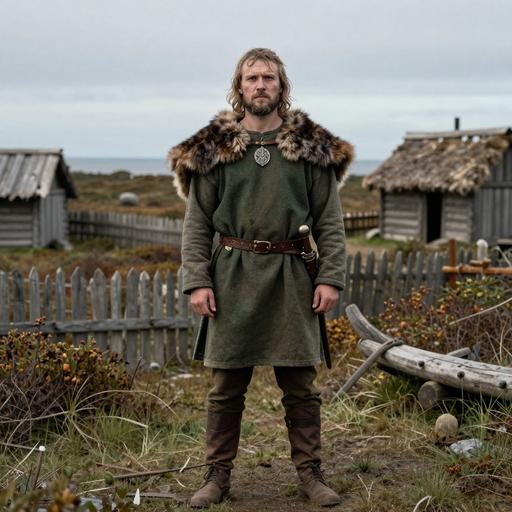
The Story
The journey of Y-DNA haplogroup I1A2A1A1D1
Origins and Evolution
Y-DNA haplogroup I1A2A1A1D1 is a very specific downstream branch of the broader I1 paternal lineage, which is one of the characteristic Y-DNA clades of northern Europe. Its deeper ancestry ultimately traces back to the post-glacial hunter-gatherer populations of Europe, but the formation of this terminal subclade is most plausibly placed in Scandinavia or adjacent north-central Europe during the early to middle Holocene.
Because this lineage sits far down the phylogenetic tree, it likely emerged through a combination of localized continuity, founder effects, and genetic drift rather than from a very large population expansion. As with many I1 subclades, its present-day distribution is shaped by later demographic processes, especially the growth of Iron Age, early medieval, and historic northern European populations.
Subclades
I1A2A1A1D1 is a terminal or near-terminal branch of I1A2A1A1D. At this level of the phylogeny, the defining value of the clade is not broad ancient population replacement, but rather the preservation of a fine-scale paternal lineage that can help identify recent shared ancestry within otherwise diverse northern European populations.
Within the broader I1 tree, related branches often show strong regional clustering in Scandinavia, the British Isles, the North Sea zone, and parts of continental northern Europe. This pattern suggests that I1A2A1A1D1 most likely belongs to a network of lineages that expanded after the Last Glacial Maximum and later became embedded in agricultural, tribal, and medieval populations.
Geographical Distribution
This haplogroup is expected to be rare but present across several parts of northern and central Europe, with the highest likelihood in regions where I1 is generally common. It may appear in:
- Scandinavia, especially Norway, Sweden, and Denmark
- Northern Germany and adjacent regions of Central Europe
- The British Isles, especially among lineages with North Sea connections
- Baltic and East Slavic populations at low frequency through historical gene flow
- Balkan and Central European populations where northern European paternal lines are present at low levels
- Diaspora populations in the Americas and Australia due to recent European migration
The distribution is consistent with a lineage that became established in northern Europe and later spread through medieval mobility, maritime exchange, and modern migration.
Historical and Cultural Significance
Although no single archaeological culture can be assigned with certainty to I1A2A1A1D1, its broader paternal background is often associated with prehistoric Scandinavian and post-glacial European hunter-gatherer ancestry, later carried into populations shaped by the Nordic Bronze Age, Iron Age, and Viking Age.
In population genetics, I1 lineages are frequently discussed in relation to northern European continuity, the formation of regional founder effects, and the spread of male-mediated ancestry during the early historic period. Very rare downstream branches such as I1A2A1A1D1 can be useful in genealogical and archaeogenetic studies because they may preserve evidence of localized male line continuity across centuries or millennia.
Conclusion
Y-DNA haplogroup I1A2A1A1D1 represents a fine-scale northern European paternal lineage rooted in the long history of I1. Its rarity and deep placement in the tree point to an origin in Holocene Scandinavia or nearby north-central Europe, followed by persistence through drift and local founder effects, with later spread across northern, central, and diaspora populations.
Key Points
- Origins and Evolution
- Subclades
- Geographical Distribution
- Historical and Cultural Significance
- Conclusion