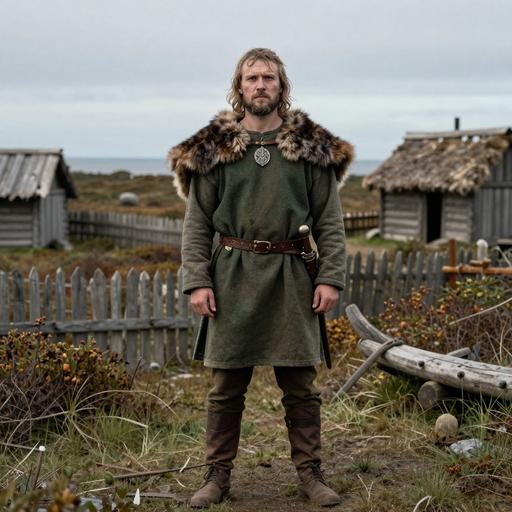
The Story
The journey of Y-DNA haplogroup I1A2A1A1D1A
Origins and Evolution
Y-DNA haplogroup I1A2A1A1D1A is a rare terminal or near-terminal branch within haplogroup I1, one of the signature paternal lineages of northern Europe. Its broader lineage ultimately descends from ancient Mesolithic European hunter-gatherer ancestry, but the specific subclade likely formed much later, during the Holocene, when small founder populations and strong genetic drift shaped the fine-scale structure of northern European Y-chromosome diversity.
Because this clade is nested deeply inside I1, its emergence is best understood as part of the long-term diversification of post-glacial Scandinavian and adjacent north-central European populations rather than as a marker of a single historical migration event. The most plausible timeframe for its formation is the Late Neolithic to Early Bronze Age, with later persistence in isolated lineages.
Subclades
As a downstream branch of I1A2A1A1D1, haplogroup I1A2A1A1D1A represents a more refined layer of paternal descent. It is expected to be rare, with very limited documented sampling, and may exist as a localized family or regional lineage rather than a broadly expanded macro-lineage. In phylogenetic terms, this kind of subclade often reflects recent branching, surname clustering, and genetic drift more than large-scale prehistoric dispersal.
Geographical Distribution
This haplogroup is expected to occur primarily in Northern and Central Europe, especially in populations with strong historical ties to the I1-rich genetic landscape of Scandinavia and Germanic-speaking regions. Based on the parent clade's distribution, it may be found at low frequency in:
- Scandinavians, especially Norwegians, Swedes, and Danes
- Germans and Austrians
- British and Irish populations
- Baltic populations
- East Slavic populations
- Balkan populations
- Central European populations
- Recent diaspora populations in the Americas and Australia
Its distribution is likely highly uneven, with a few local clusters and many populations showing only sporadic occurrences.
Historical and Cultural Significance
Haplogroup I1 is strongly associated with the paternal heritage of northern Europe, especially populations that later participated in the formation of Germanic and Scandinavian ethnolinguistic groups. While I1A2A1A1D1A itself cannot be directly tied to a single named archaeological culture without additional ancient DNA evidence, its broader ancestral context overlaps with the demographic transformations of the Neolithic, Bronze Age, and Iron Age in northern Europe.
In practical population-genetic terms, rare subclades such as this are often informative for reconstructing regional ancestry, local founder effects, and historical continuity within families or small communities. They may also be useful in genealogical studies because they can sometimes correspond to narrowly defined paternal lineages within modern populations.
Conclusion
I1A2A1A1D1A is a rare and highly specific branch of haplogroup I1, likely originating in Scandinavia or nearby north-central Europe during the Holocene. Its importance lies less in broad prehistoric migration and more in the preservation of a localized paternal lineage shaped by founder effects, drift, and regional continuity in northern Europe.
Key Points
- Origins and Evolution
- Subclades
- Geographical Distribution
- Historical and Cultural Significance
- Conclusion