


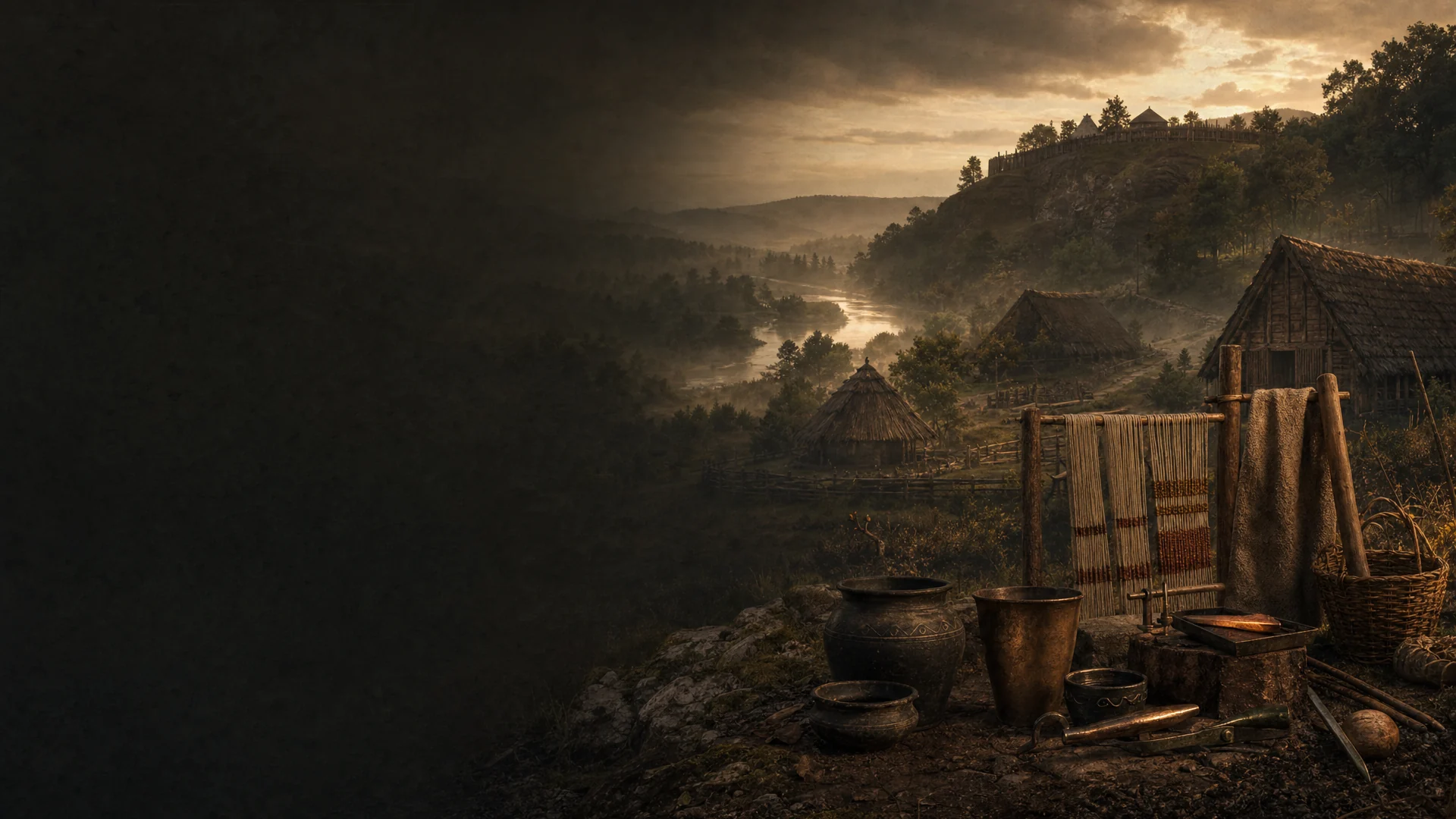

The Story of Ancient Central Europe
Around 5,500 BCE, the first Linear Pottery farmers pushed east along the Danube and its tributaries, bringing cereal cultivation and permanent villages to a landscape long held by post-glacial foraging communities.
By the late third millennium BCE, Corded Ware herders and then Bell Beaker groups reshaped much of the region's gene pool, a transition detected in ancient DNA as one of the largest population turnovers ever documented in Europe. Their descendants built the Unetice bronze workshops of Bohemia and Saxony-Anhalt, whose princely burials, like the Leubingen tumulus, reveal Bronze Age Central Europe's earliest social hierarchies.
Iron Age communities at the crossroads of the Hallstatt, Vekerzug, and La Tene traditions left cemeteries across Slovakia and Bohemia that mix inhumation and cremation practice. When Rome extended its frontier to the Danube, provincial communities settled along the limes, leaving material culture that blended local and imperial traditions.
In the centuries after Rome's frontier receded, Avar-period cemeteries in the Vienna basin and Lombard-period burials near Lake Balaton document a landscape in motion, while towns like Nitra grew into early centers of Slavic-speaking power in the middle Danube. From Linear Pottery farmsteads to early medieval river valleys, these groups remain reference populations for genetic similarity, not a personal record of descent.
River valleys, bronze workshops, and the Roman frontier are reference contexts. A match shows genetic similarity, not descent.
Mesolithic Foragers
10,000 to 5,500 BCEPost-glacial hunter-gatherer communities who occupied Central Europe's rivers and forests before farming arrived.
Linear Pottery Farmers
5,500 to 4,500 BCECentral Europe's first farming communities, spreading the Linear Pottery tradition along the Danube corridor.
Corded Ware & Bell Beaker
4,500 to 2,200 BCECopper Age communities whose herding lifeways drove one of the largest population turnovers detected in ancient DNA.
Unetice & Urnfield
2,200 to 800 BCEBronze Age societies whose workshops and princely burials, like the Leubingen tumulus, reveal early social hierarchy.
Hallstatt & La Tene
800 to 50 BCEIron Age communities at the crossroads of the Hallstatt, Vekerzug, and La Tene cultural traditions.
Roman Frontier
50 BCE to 500 CEProvincial communities who lived along the Danube limes, where Rome's frontier met Central Europe's interior.
Avar & Early Medieval
500 to 1500 CEEarly medieval communities, from Avar-period cemeteries near Vienna to the rise of Slavic centers like Nitra.


Trusted by 200,000+ DNA Explorers
Real, verified reviews from people who have explored their genetic similarity with DNAGENICS
Great reports like the "Human Leukocyte Antigen" Report. The Deep Ancient Reports with Samples are very helpful to understand the Results and own Heritage. I like the Admixture Studio and the powerful G25 Studio.
DNAGenics is an excellent company. It provides necessary services for those of us who need help understanding and working with complex genetic information. They are efficient in their communications. I recommend them without hesitation.
Excellent company with helpful customer support that always respond very quickly. There are always new features and the purchase packs include a lot of admixture reports and G25 coordinates. Highly recommend.